
Migration is Beautiful
"Meet powerhouse artist/activist Favianna Rodriguez — a leading voice in the movement of artists raising awareness about U.S. immigration issues."
- I am OTHER

Harvest of Empire
The Untold Story of Latinos in America “We are all Americans of the New World, and our most dangerous enemies are not each other, but the great wall of ignorance between us.”
Juan González, Harvest of Empire

Featured Post
Migration is Beautiful | Favianna Rodriguez | I am OTHER
"Meet powerhouse artist/activist Favianna Rodriguez — a leading voice in the movement of artists raising awareness about U.S. ...

Showing posts with label human rights. Show all posts
Showing posts with label human rights. Show all posts
Monday, March 9, 2015
Recent Pattern of Unarmed Mexican Immigrants Killed in U.S.
W/ 3 unarmed Mexican immigrants being killed by American police in the past month, the Mexican consulate is involved
http://t.co/RfFR0jo9fH
— Shaun King (@ShaunKing) March 3, 2015

Saturday, July 5, 2014
Friday, May 9, 2014
The Reasons Why So Many Female Celebrities Avoid the F-word, and Why We Should Care

Shailene
Woodley of recent Divergent fame has recently come under fire from all sides by various feminist bloggers
for telling TIME magazine in an interview she is not a feminist. An excerpt:
TIME: You've talked before about being conscious of the kind of messages that you're sending to young female fans when you’re taking on roles. Do you consider yourself a feminist?
Woodley: No, because I love men, and I think the idea of “raise women to power, take the men away from power” is never going to work because you need balance.
One of
the major reasons this matters, apart from the innate inaccuracies of her
interpretation of feminism, is because just two months before this interview,
TIME published a blatantly contradictory piece entitled Why Hollywood Desperately Needs ShaileneWoodley with a byline that proclaims: “The 22-year-old Divergent star turns
out to be the outspoken feminist role model we've been waiting for.” Perhaps not.
She is
not alone in her shying away from the “F” word. Just a handful of female
celebrities’ responses to, “Do you consider yourself a feminist?”:
Katy Perry: “I am not a feminist, but I do believe in the strength of women.”
Taylor Swift: “I don't really think about things as guys versus girls. I never have. I […] think if you work as hard as guys, you can go far in life.”
Bjork: “[I don't identify as
feminist] because I think it would isolate me. I think it’s important to do
positive stuff. It’s more important to be asking than complaining.”
Lady Gaga: “I'm not a feminist. I
hail men, I love men, I celebrate American male culture – beer, bars, and
muscle cars.”
Kelis: “Call it
what you want. I am extraordinarily happy to be a woman. I would not change it
for the world. I think men should run the world because if not there would be
no balance. […]All these titles are just so useless.”
In these statements is a pattern of a few things:
1.
“I’m not
a feminist but…[I do agree with key components of feminism”
2.
“I love
men and I like the way things are. I don’t feel the need to compromise that.”
3.
“Feminist
is an extreme word.”
Clearly, either these celebrities are very confused or feminism has an image problem.
Much of the tip-toeing around the term stems from its deep-rooted association
of a furious, high-strung, bra-burning, non-shaving, man-hating feminists of
the 1960s, 70s, and 80s. These hyphenated descriptors can seem intimidating and
unglamorous for your standard female celebrity.
 |
| The term "feminist" carries a lot of negative stigma from damaging and insulting stereotypes indicative of the extreme, sensationalist stories and images perpetuated by popular media. It's not helped by prominent figures in society who buy into the stereotypes as well. |
Fortunately, the likes of Ellen
Page, Natalie Portman, Wanda Sykes, Emma Stone, Zoe Saldana, and Amy Poehler
are among those who openly, fervently embrace the ideals of feminism. Beyoncé, who of course cannot be ignored in
any discussion of feminism, released her eponymous album late last year that
has been lauded for its power anthems that turn the conventions of male-dominated hip-hop
on its head.
“***Flawless” explicitly uses a sample of Chimamanda Ngozi Adichie’sTED talk on feminism that lays out the most straightforward definition of the term:
“***Flawless” explicitly uses a sample of Chimamanda Ngozi Adichie’sTED talk on feminism that lays out the most straightforward definition of the term:
“Feminism: the social, political,
and economic equality of the sexes.”
Beyoncé
in particular has always been controversial for her ever-evolving, and
increasingly sensual, persona. For some,
willfully and proudly reclaiming one’s sexuality is empowering. For others, traditional
subordinate woman roles is considered natural and therefore empowering. The
trouble is that when it comes to defining feminist values the contradicting ideas
can be confusing and thus, alienating.
 |
| Debate abounds about whether Beyonce is a "true" feminist. Either way she is considered one of the most successful pop icons of our time, and she recently penned an essay on the oft-mentioned wage gap and gender equality that can be downloaded here. |
The kind of feminism we should be striving to uphold is one that is
inclusive of all lifestyles, all races, all sexualities. Based on a definition
that emphasizes equality, women should be free to live and behave as they
prefer, whether as a politician or a housewife, dressed in short skirts or T-shirts, so long
as they aren't diminished or otherwise treated differently. It’s a call to obliterate
the oppressive virgin-whore dichotomy that pigeonholes young women everywhere
and a call that tells them they don't have to choose between identifying with
femininity or masculinity without ridicule. Feminism supports the idea that a woman's decisions should not be contingent on her gender. That’s the essential core of the
equality values of feminism. All other feminist issues such as reproductive
rights, working to abolish rape culture, reconstructing the way women are
portrayed in media follow suit.
Therefore,
when female celebrities say something along the lines of, “I'm not a feminist,
but I believe women are equal to men” they’re essentially saying, “I don't
agree with the exaggerated, distorted idea of feminism I understand, but I still
hold feminist views” should be observed as purely an issue of image.
What
the average feminist-identifying individual person can do to combat this is
publicly call out those (on social media or otherwise) who are reinforcing
hateful, unconstructive attitudes not central to the core of classic feminism.
That’s not to say that anger has no place in social justice activism or that we
should be primarily concerned with tone-policing, but rather sisters should be
helping sisters push for feminist issues in solidarity and correct each other
when necessary. Superficial as it may seem, the more positively received
feminists are, the more attention and support it’s going to get. Mainstream
media likes to focus on sensationalist stories that capitalize on instances of extremely
unsavory acts played out in the name of feminism. Small gestures witnessed by
peers will help to reinvent the public’s idea of feminism.
 |
| In her latest interview with TIME and further demonstration of her underdeveloped ideas regarding feminism, Woodley praised this summer's The Other Woman for its supposed celebration of sisterhood, but failed to recognize the inherently shallow, sexist cliches therein. |
No one
can force anyone to identify herself as feminist, and it’s inevitable people
are going to fall on various ends of the spectrum of feminist thought. Female
celebrities in general can’t be blamed for prioritizing their image over
accepting the responsibility of carrying the feminist cause on their shoulders.
Objectification
of women in popular media and the narrow range of roles women are offered in
television and film are pertinent to female celebrities. It’s natural for the
general public to want to know their general stance on these issues, hence why
they are frequently asked about feminism. Whether we like it or not, their
answers matter because celebrities often act as role models for the casual
audience. Even for the more critical viewer, celebrities can act as barometers
of where the general public stands on social issues. Celebrities exist to
entertain and fans consequently exist to want to relate to them. When a credulous
fan’s favorite singer says something along the lines of, “I’m not a feminist
because I love men and I like to be taken care of” and identifies with that statement,
it weakens the feminist movement as a whole and fosters an entire cohort of
young women who may equate feminism with hating men. A celebrity who distorts
the definition of feminism mislead fans from a mass effort that extends love
across genders.
Woodley
has three more installations of the Divergent films lined up and The Fault in
Our Stars coming out later this summer and is already being hailed as one of
Hollywood’s best and brightest young stars. Overall she seems to be socially
aware, articulate and well-spoken. Some of her views seem to align with
elements of feminism while others are up for debate. She’s young, not much
older than me, and has plenty of time throughout her career to develop her
stance. By no means is Woodley obligated to come out and identify as a
feminist. But for the sake of her clamorous and ever-growing fanbase of
impressionable young girls, I hope she does.
Saturday, May 25, 2013
Sunday, November 18, 2012
The Largest Mass Execution in U.S. History
"The President's honored on Mt. Rushmore were very aggressive in their treatment of Native Americans. In this episode of The Massachusetts School of Law's Educational Forum Assistant Professor of law Kurt Olson interviews host and producer of First Voices Indigenous Radio's Tiokasin Ghosthorse.
The Massachusetts School of Law also presents information on important current affairs to the general public in television and radio broadcasts, an intellectual journal, conferences, author appearances, blogs and books."
Thursday, October 11, 2012
Teachers 4 Social Justice Conference
 |
| Mission High School San Francisco, CA |
Teachers 4 Social Justice Conference is an annual free event held in San Francisco, California
The event is open to anyone and everyone; not just teachers.
This year they had two keynote speakers. The morning keynote speaker was Sean Arce, former Director of Mexican American Studies in the Tucson Unified School District. The evening speaker was Sonia Nieto, Professor Emerita of Language, Literacy and Culture at the School of Education, University of Massachusetts Amherst.
After the first keynote speaker the audience broke out into different classrooms. This was held at Mission High School, so you actually sit in a high school classroom to learn your topic of Social Justice. The list of classes offered in 2012 is here.
 |
| Dolores Park with view of Mission High School San Francisco, CA |
 |
| Photo from Taj M. on Yelp |
 |
| Photo from Dave H. on Yelp |
When you return from lunch you see the second keynote speaker. After that you breakout into your workshop in another classroom.
I attended "Rethinking The 'Line Between Us' Bringing History Alive In The Classroom" which was taught by none other than Bill Bigelow, author of the banned book "Rethinking Columbus" and a Social Studies teacher for almost 30 years who had taught in Oregon. And yes, he taught about the U.S. Mexico boarder even though he was one state away from the border.
In class he had us read a couple paragraphs from a slip of paper about a real character from the Mexican-American War. He had us assume the role of that person, name tag and all, then go around the class and find another real character who had something to gain from the war; who had something to loose from the war; and someone who didn't care either way.
I really enjoyed the day and hope to make it back every year.
You can follow Teachers 4 Social Justice on Facebook, Twitter and WordPress
Although their conference is free they do ask for at least a $5 donation.
Thursday, July 21, 2011
Emotions on Immigration topics run High

I ran across this epic comment on an Immigration blog post and felt compelled to re-post the comment.
The topic is very serious, very sad and his over the top anger is funny at the same time.
"And let’s continue with the policy of reducing human beings to nothing more than their economic function. Nothing else matters – not culture, not sentiment, not family, not history, not morals. Just how much goddamned labor one goddamned person can produce per goddamned hour, for whatever goddamned price businesses want to pay – and not a goddmaned penny more!" -Bubba
Monday, November 22, 2010
Injustice on Our Plates: Immigrant Women in the U.S. Food Industry
"Legalizing undocumented workers would raise the U.S. gross domestic product by $1.5 trillion over a decade. On the other hand, if the government were to deport all 10.8 million undocumented immigrants living on U.S. soil, our economy would decline by $2.6 trillion over a decade, not including the massive cost of such an endeavor.
Each year, undocumented immigrants contribute as much as $1.5 billion to the Medicare system and $7 billion to the Social Security system, even though they will never be able to collect benefits upon retirement."
Each year, undocumented immigrants contribute as much as $1.5 billion to the Medicare system and $7 billion to the Social Security system, even though they will never be able to collect benefits upon retirement."
- A mere 8 percent of farmworkers report being covered by employer-provided health insurance, a rate that dropped to 5 percent for farmworkers who are employed seasonally and not year-round.7
- According to the U.S. Department of Labor, farmworkers suffer from higher rates of toxic chemical injuries and skin disorders than any other workers in the country.8 The children of migrant farmworkers, also, have higher rates of pesticide exposure than the general public.9
- Each year, there are an estimated 10,000 to 20,000 cases of physician-diagnosed pesticide poisoning among U.S. farmworkers, according to the U.S. Environmental Protection Agency.10
- Farmworkers are not covered by workers’ compensation laws in many states. They are not entitled to overtime pay under federal law. On smaller farms and in short harvest seasons, they are not entitled to the federal minimum wage.11 They are excluded from many state health and safety laws.12
- Because of special exemptions for agriculture, children as young as 10 may work in the fields. Also, many states exempt farmworker children from compulsory education laws.
Thursday, August 12, 2010
American Brainwash
If you grew up in the U.S. - do you feel the history you were taught was incomplete?
In kindergarten I learned the song "This land is your land..."
The song made me feel like the whole U.S. was for everyone. The song doesn't mention the land was occupied for 40,000 years before the English arrived.
In fourth grade I learned the history of the U.S. trafficking humans from Africa. I didn't learn in grammar school that in America there were many white slaves called indentured servants. I also didn't learn in grammar school that indigenous native American's were sold as slaves.
Another area I was mis-lead is that the U.S. government uses the term "Indian" for people who are not Indians, but indigenous Native Americans. The reason our government and our society has decided to call indigenous Native American's "Indians" is because if the correct term term was used, the non-indigenous would constantly be reminded that this land was stolen from the original owners.
We are bombarded with the term 'race' as if there are just 3 races (or 4, or 6 or 30) in the world and everyone can check a box to fit into one of those categories.
Here's the poetic truth: There is one race - the human race.
Here's the scientific truth: There is one human species - the human species.
Here's the anthropological truth: There are no races - only clines.
What is a cline? It means subtle variations. In this case it means subtle variations based on geographic differences within a species.
What important information do you feel was missing in your childhood education?
Friday, July 2, 2010

Tuesday, June 29, 2010
What Creates Our Identity
 |
| Chart by Glenn Robinson of CommunityVillage.us -- click to enlarge |
Charts to assist those who ask
"What are you?"
and
"What am I?"
"What are you?"
and
"What am I?"
 |
| Chart by Charo Robinson |
Make your map free at bubbl.us

Our identity is made up of our culture, our nature and our self.
It has been illegal for the government of France to collect data on ethnicity and race since 1789.
However, civil rights lawyers in the U.S. use 'race' data to prove discrimination.
Colors are not races.
People are Tints and Shades of flesh color.
 Original photo from National Geographic.
If there were black and white people, their offspring would be grey.


"Citing Blumenbach by name, Emerson agrees that races shade into each other imperceptibly."
-Nell Irvin Painter, The History of White People
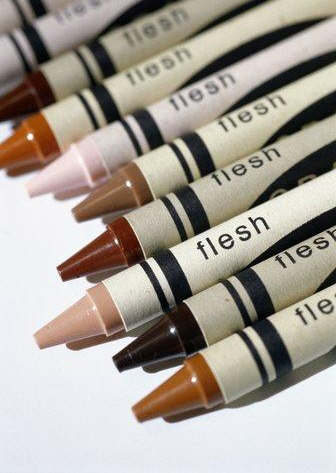 The 'race' check boxes are not derived from physical science, but from political science with an underlying ideology of exclusion.
Makeup from brushesbykaren


Hair from headkandy
In 1997, the American Association of Physical Anthropologists urged the American governmnet to phase out the use of race as a data category and to substitute ethnic categories instead. Geneticists studying DNA ... were also concluding that race as a biological category made no sense. --Nell Irvin Painter
Some chapters from the book
"Modernizing the U.S. Census"
Modernizing the U.S. Census
Modernizing the U.S. Census
Modernizing the U.S. Census
YouTube response explaining One Human Race
Here is the information I could not find on the US census website. The answers to the questions: How many 'race' categories does the US feel are worthy of recognizing? Why has the US been collecting data on race and ethnicity? How is the data used?
From the webpage:
A Brief History of Census “Race”
Frank W. Sweet, author of Legal History of the Color Line
Changes in “Racial” Categories
Changes in Stated “Racial” Goals
-Frank W Sweet, A Brief History of Census “Race”
Multiracialism In America - Jane Junn
Choose one or more:
☐ Mixed
☐ Other
☐ Unsure
☐ Don't know
☐ None of your business
Snoop finds out what percentage of Native American, European and African he is.
Should I stop using the word "race"?
Unless you are a physical anthropologist, or discussing the word itself, the word 'race' should be avoided.
Replace the word 'race' with ethnicity. True, the meaning is different, but conversations about human differences usually revolve around ethnic differences.
The term 'race' equates to the noun 'breed'. Humans do not want to be thought of as breeds. -getgln
Nell Irvin Painter
Professor of American History, Princeton
Speaking about the History of White People
Using the term 'race' runs the risk of sounding uneducated, and worse, the risk of sounding racist.
NYTimes.com - Being Multiracial in America
Mixed
Listen at 3:20
Subscribe to:
Posts (Atom)